Wolf Range Repair
Wolf Burner Lights With a Bang: What the Delay Is Telling You
A sealed Wolf burner that thumps instead of catching quietly is gas pooling before the spark takes. What causes the delay, the two faults behind almost all of them, and what to check in a Phoenix kitchen before anyone opens the manifold.
Written by Dallas McGivern Cooking-appliance technician — griddles and charbroilers · 10 years in the trade
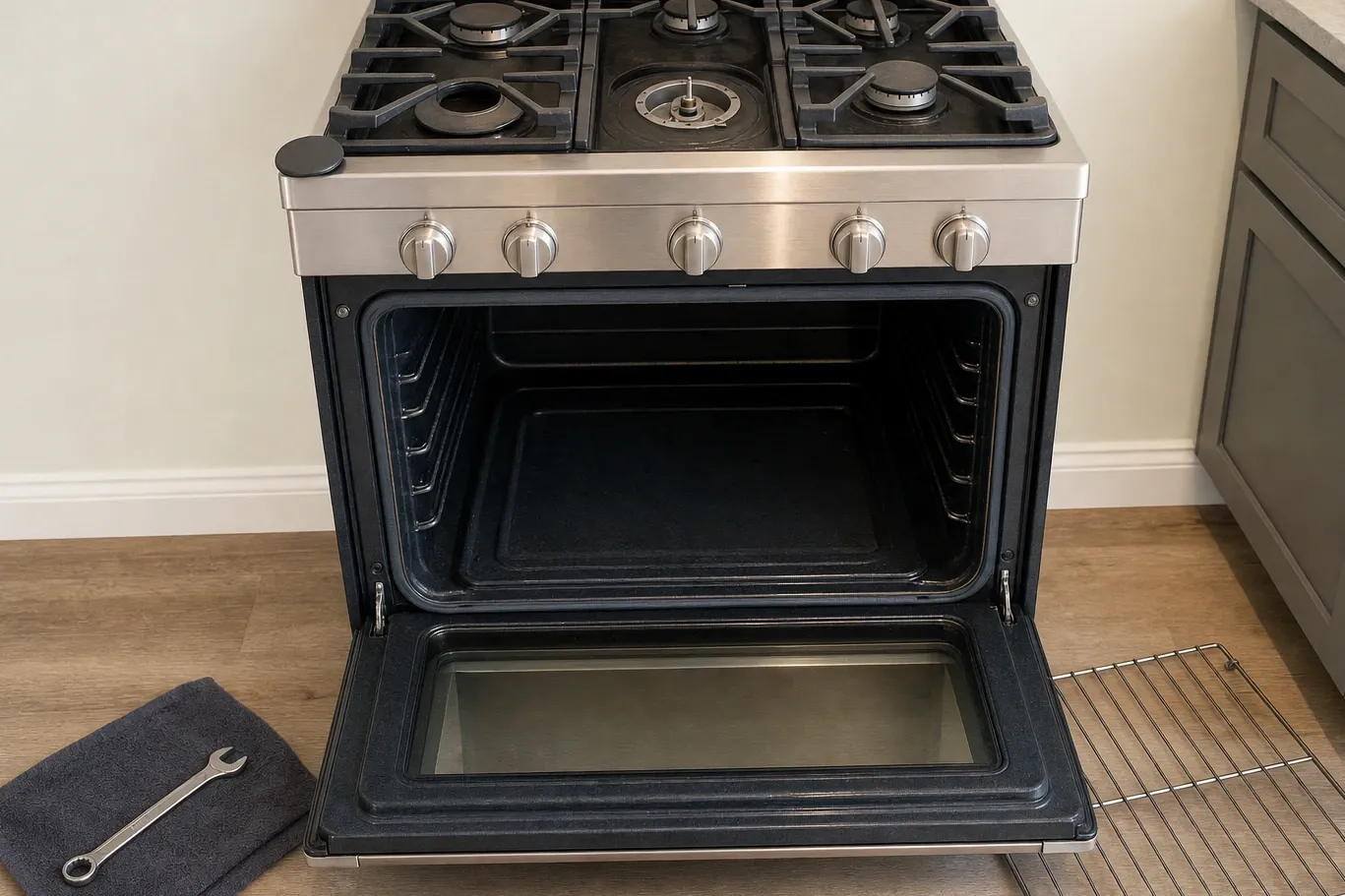
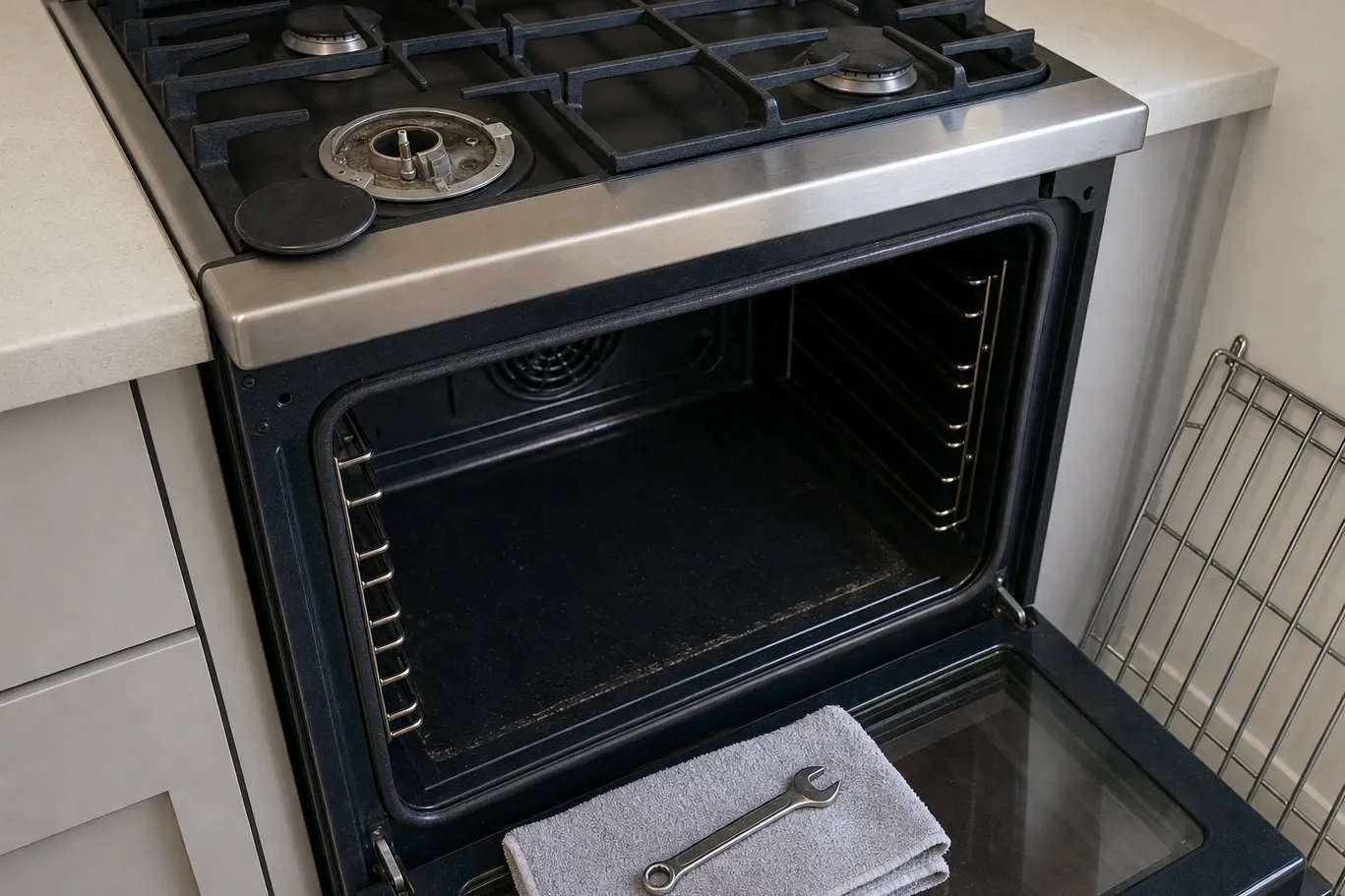
A healthy sealed burner on a Wolf rangetop catches almost silently. You hear the valve, you hear two or three clicks, and the ring lights all the way round in the same instant. When it thumps instead — a soft detonation you can hear in the next room, sometimes with a puff of flame that jumps past the cap — the burner is telling you something specific and mechanical. Gas left the ports before the spark was able to light it, so instead of igniting at the source it collected, mixed with air, and then went off all at once.
That is delayed ignition, and it is one of the few cooktop faults where the symptom names the cause almost precisely. The question is never whether the spark arrived late. The question is why.
What the bang actually is
Every burner has a start-up sequence measured in fractions of a second: the valve opens, gas reaches the port ring, the electrode sparks, and the flame propagates from the electrode round the ring. Anything that lengthens the gap between the first and third step gives gas time to accumulate. A quarter of a second is invisible. Half a second is a soft thump. A full second is the bang that brings somebody into the kitchen to see what happened.
Two things lengthen that gap. Either the spark is weak, late or landing in the wrong place, or the gas is arriving somewhere other than where the spark is. Both feel identical from the front of the range, and both look identical if you simply light the burner and watch. Telling them apart means lifting the cap.
The two faults behind almost every one
A fouled or wet igniter cap. A boil-over runs down into the burner well and bakes onto the ceramic. What is left behind is not just dirt, it is an insulator — the spark energy leaks across the deposit instead of jumping cleanly to the burner body. On a range that has cooked a few pots of rice over the years this is the single most common cause, and it is a cleaning job rather than a parts job. The tell is a stained, glazed-looking electrode and a burner that lights better when it is bone dry than after somebody has wiped the cooktop.
A cracked electrode. The ceramic insulator around the electrode is brittle, and it lives through several hundred degrees of thermal cycling a week. When it hairlines, the spark starts tracking down the crack to the nearest metal instead of arcing where it should. This one usually gets worse in a straight line — a slight delay for a fortnight, then a proper bang — and no amount of cleaning helps. It is a small part and a quick change, but it has to be diagnosed rather than guessed, because a new electrode fitted to solve a blocked-port problem changes nothing.
There is a third possibility worth naming because it is the one that gets misdiagnosed most: blocked ports on the side of the ring nearest the electrode. The spark is fine and the electrode is fine, but there is no gas at that point of the ring, so the flame has to start somewhere further round and travel back. That reads as a delay and sounds like a bang, and the fix is a brass brush and ten minutes.
What you can check before anybody comes out
Do this cold, with the burner off and the knob down.
- Lift the burner cap and the ring. Look at the electrode: stained and glazed points at cleaning, a visible hairline in the white ceramic points at a part.
- Hold the cap up to a light. If the underside is carbonised and the ports look narrowed, the ring needs clearing.
- Brush the ports with a soft brass brush, never steel, and never a needle or a paperclip. Enlarging a port permanently changes how that burner behaves.
- Sit the cap back down properly. A cap resting a millimetre off its seat, or on a smear of dried spill, will produce the same delay on a burner with nothing whatever wrong with it.
- Light the other burners and pay attention. If all of them are slightly rough, stop looking at the burner and start thinking about supply pressure.
That last point matters more here than most guides admit. If every burner lights badly and the flames also lift off the ports or roar at the low setting, the story is at the regulator and the meter, and cleaning burner caps all afternoon will not touch it.
Why Phoenix kitchens do this more
Two local reasons, and neither is imaginary.
The first is dust. After a haboob the fine grit gets everywhere, including into the venturi and the port ring of an open burner. It does not block a port on its own, but it holds grease and it changes the air mixture, and a burner that was marginal becomes a burner that thumps. The kitchens out in Estrella and along the west side see this first because there is open ground upwind.
The second is what a monsoon power cut does to a dual-fuel range. The burners keep working on their own valves, but the spark module is electric, and a brownout followed by a hard restart is not kind to it. A module that has been knocked about fires weakly across every channel — the same late spark on all five burners at once, which people usually describe as the whole cooktop has gone funny rather than as an ignition fault.
When it stops being a nuisance
Live with a small thump for a week if you must, but book it if any of these are true: the delay is getting longer, the flame jumps outside the cap, the burner has scorched the trim around it, you can smell gas in the seconds before it lights, or the same fault has appeared on more than one burner. The first four say the volume of gas involved is growing. The last says the cause is not the burner at all, and no amount of cleaning is going to find it.
Bring the model number when you ring. On a rangetop it is on the frame under the front lip; on a freestanding range it is behind the kick panel or on the door frame. It decides which electrode and which port ring, and it is the difference between the part travelling out on the first visit and a second appointment nobody wanted.
Follow-ups
Is a burner that lights with a bang dangerous?
It is not an emergency, but it is not something to live with either. The thump is a small volume of gas igniting all at once because the spark arrived late. The volume grows as the fault worsens, and a bad enough delay can lift a burner cap or scorch the surrounding trim. Use another burner and get it looked at.
Why does only one burner do it?
Each sealed burner has its own electrode, its own orifice and its own port ring, so a fault stays local. When every burner on the cooktop lights badly at once the cause is usually upstream instead — gas pressure at the regulator, or a spark module firing weakly across all channels.
Can I clean the igniter myself?
You can lift the cap and the burner ring when the cooktop is cold and brush the ports clear with a soft brass brush. What you should not do is scrape or wet the ceramic electrode, or poke the ports with anything steel — both turn a cleaning job into a parts job.
Does the clicking that continues after it lights mean the same thing?
No, that is a different fault. Continuous clicking with a lit burner is normally a stuck spark switch under the knob or moisture bridging a terminal, and the ignition itself may be perfectly healthy.